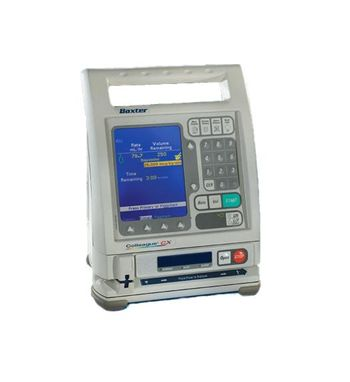
Baxter Colleague Single Monochrome
 Baxter International · Model Colleague Single Monochrome
The Colleague Monochrome pump can be customized with selectable performance parameters for a diverse range of care sites and therapies.
Key tips
- ·Free-flow protection must be verified on every PM - a failed anti-free-flow clamp is a direct overdose risk.
- ·Test occlusion alarms in both directions - failing to alarm when it should is more dangerous than a false alarm.
- ·Battery run-time complaints are the most common real-world nuisance call - a full charge/discharge cycle test catches most of them.
Typical Failure Modes
Compiled for this model from its own documentation and established engineering knowledge for this equipment class - not from a verified service record. Confirm against the manufacturer's service manual.
Failure / error message stops delivery
HighSymptoms: The pump alarms and displays an error message / code and stops.
Root cause: A subsystem fault indexed in the service manual - motor / drive, a sensor, set-detection, or a board.
Occlusion alarm / pressure fault
MediumSymptoms: Repeated occlusion alarms, delivery stops, or an occlusion is missed.
Root cause: Kinked or clamped line, a closed roller clamp, a positional patient tube, pressure-sensor drift, or an improperly loaded set.
Air-in-line alarm
MediumSymptoms: Frequent air-in-line alarms, delivery stops.
Root cause: Air in the set, an improperly loaded set, or an ultrasonic air-detector fault.
Flow-rate accuracy drift
MediumSymptoms: Delivered volume outside tolerance on the annual test, especially at low rates.
Root cause: Worn pumping mechanism / plunger drive.
Battery will not hold charge
MediumSymptoms: Short run time, low-battery early after a full charge.
Root cause: Aged battery pack.
Door / plunger / sensor mechanical wear
LowSymptoms: Set will not load, door will not latch, plunger grip poor.
Root cause: Worn door latch, plunger jaws, or anti-free-flow mechanism.
Serviceable Parts & Consumables
Serviceable items for this model, compiled from its documentation and engineering knowledge for this equipment class. Service class and relative cost are estimates, not manufacturer figures; no part numbers are given. Confirm intervals and pricing against the manufacturer.
Battery pack
Class Periodic replacementRel. cost $$R&R Fairly easy
Pumping mechanism / rotor / plunger drive
Class Major service partRel. cost $$$R&R Difficult
Pressure / air-detector sensor assembly
Class Major service partRel. cost $$R&R Moderate
Door / latch / anti-free-flow assembly
Class Major service partRel. cost $$R&R Moderate
Drive motor / gearbox
Class Major service partRel. cost $$$R&R Difficult
| Part | Service class | Relative cost | R&R difficulty |
|---|---|---|---|
| Battery pack | Periodic replacement | $$ | Fairly easy |
| Pumping mechanism / rotor / plunger drive | Major service part | $$$ | Difficult |
| Pressure / air-detector sensor assembly | Major service part | $$ | Moderate |
| Door / latch / anti-free-flow assembly | Major service part | $$ | Moderate |
| Drive motor / gearbox | Major service part | $$$ | Difficult |
Relative cost: $ lowest · $$$$ highest service-part cost for this equipment class. Not a price.
PM Checklist
Preventive-maintenance tasks typical of this equipment class. Perform to the manufacturer's procedure and your facility's policy - this is general reference, not a schedule for this specific unit.
- ·Occlusion pressure and flow-rate accuracy verification
- ·Battery conditioning cycle
- ·Door latch and air-in-line sensor inspection
- ·Post-drop functional check before return to service
- ·Annual PM per manufacturer schedule
Troubleshooting Approach
A starting sequence for this model, compiled from its documentation and engineering knowledge for this equipment class. Follow the manufacturer's service documentation for the actual procedure.
Symptom: Error message or code
- Note the exact error message / code.
- Look it up in the pump's technical service manual troubleshooting section.
- Use the biomed diagnostics / utilities to test the affected subsystem.
- Follow the manual's parts-replacement procedure.
- Run the scheduled-maintenance test set (including flow accuracy) after any repair.
Symptom: Occlusion or delivery problem
- Check the line for kinks, clamps and a closed roller clamp; check the patient site.
- Reload the set correctly, clearing all air.
- Confirm an approved set for this pump.
- Run the pressure / air-detector (or rotor) test in diagnostics.
- Replace the set; refer the pump if a sensor / mechanism fault is indicated.
Typical Location
Where this class of equipment is typically deployed - general reference, not this unit's own placement record.
- Patient care floors
- ICU
- OR
- Oncology / infusion centers
- Home health (portable pumps)
Documents & Manuals
No documents available for this device yet.
Safety & Recalls
Synced live from the FDA openFDA API.
- RECALL
There have been reports of air and medication leakage from the nebulizer cup during therapy of Volara system patient circuits. The leakage can lead to an oxygen level drop in the patient and ineffective nebulization, which may affect the delivery of the prescribed treatment. The issue has been associated with improper locking of the nebulizer cup after adding medication during user setup.
- RECALL
Urgent Medical Device Correction for the Volara system single-patient use circuit due to the potential that patients or caregivers may be unaware of a possible decrease in oxygen levels (oxygen desaturation), or potential lung tissue injury from overexpansion (barotrauma) when the Volara device is used in the home care environment. This correction is providing the home caregiver specific instructions for use.
- RECALL
Baxter Healthcare Corporation is issuing an Urgent Medical Device Correction due to customer reports of thermal skin injuries when using the iLED 7 surgical light system products listed below. Specific VidiaPort and Trulight product codes are also impacted as they are equipped with iLED 7 light-heads
- RECALL
Potential of the handset plug to disconnect from the nebulizer port on the blue ventilator adapter. The handset plug is required to ensure proper operation and ventilator gas flow.
- RECALL
There is a potential leak between the venous patient connector and patient's hemodialysis access.
- RECALL
complaints of kinked access lines observed during treatment using cartridge sets for hemodialysis treatments were received.
- RECALL
There were customer reports of separation between the tubing and Male Luer Lock Adaptor.
- RECALL
Potential disconnection of tubing set.
- RECALL
Potential presence of particulate matter on the blood side of the dialyzer
- RECALL
Instructions for use booklet may puncture the outer Tyvek lid.
- RECALL
Baxter Corporation is conducting a field action for the ABACUS SE and ME models due to the possibility that the compounder will load the incorrect formula upon scanning the bag label when two or more different formula files have been created with the same order number.
- RECALL
Potential for device malfunction resulting in flow when the device should not be flowing
- RECALL
1. ABACUS v3.1 may calculate quantities of electrolytes that are double the expected values during the creation of TPN orders. 2. ABACUS v3.1 may automatically add additional sterile water to a formula equal to the volume of a premix resulting in an over dilution. 3. All software versions of ABACUS software display the calcium phosphate curve points for Premasol incorrectly. 4. All software v
- RECALL
Baxter Healthcare Corporation is issuing a voluntary correction for ABACUS Total parenteral Nutrition (TPN) Calculation Software versions 2.0 through 3.0 due to the possibility that a patient could receive another patient's TPN order as a result of data corruption.
- RECALL
Incomplete foil seal on one lot of sterile product.
- RECALL
Due to an increase in complaints for leaks at the distal male Luer and Luer cap. Baxter implemented enhancements to the blue winged cap to improve the seal between the cap and the Luer.
- RECALL
Customers have reported that when separating an individual package from its attached grouping, the adjacent package has opened, compromising its sterile barrier properties.
- RECALL
The Tina System was released to the customer with OOS values for the Pressure Displays Accuracy and Leakage Rate Test.
- RECALL
Baxter's Service Center tested and returned to the user the Colleague infusion pump that did not meet PSIG (Pounds-force per Square Inch) specifications
- RECALL
The Colleague infusion pump may not have met certain Air in Line (AIL) specifications after testing by the Baxter Global Technical Service Center. This issue could potentially cause a delay in initiation of therapy.
- RECALL
A review of Baxter service records indicates that the Baxter Colleague CX Infusion Pump has not met certain voltage specifications. This issue could potentially cause a delay in initiation of therapy.
- RECALL
While replacing a defective pump head mechanism and performing calibration, Baxter's Service center may have failed to apply GLYPTOL (a red insulating varnish) on a potentiometer that helps maintain pump accuracy for detecting an air bolus.
- RECALL
The Air In Line (AIL) test was not properly performed by the service technician at the Service Center.
- RECALL
The Hi-Pot safety testing may not have been conducted on the affected pumps during service, prior to being returned to the end user.
- RECALL
Some of the Single Day Infusor System 2 mL/h have a foil over-pouch that was incorrectly labeled as the Half Day Infusor System 5 mL/h, product code 2C1073KJP, lot 10H054.
- RECALL
While the infusion pump was being serviced at the Baxter Service Center, it was inadvertently routed to the packaging area before the final inspection.
- RECALL
The Air In Line (AIL) test was not properly performed by the service technician at the Service Center.
- RECALL
The FDA sent a letter to Baxter on April 30, 2010, ordering the company to recall and destroy all models of its Colleague Volumetric Infusion Pumps currently in use in the United States. FDA determined that this action is necessary, as Baxter has failed to adequately correct, within a reasonable timeframe, the deficiencies in the Colleague pumps still in use. This recall is a consolidation of al
- RECALL
Baxter's Service Center did not perform the ground impedance and leakage current test which verify if any power overflow occurs and that it is properly discharged through the device electrical system.
- RECALL
Some of the 1550 Hemodialysis Instruments may have replacement circuit boards with incorrect versions of software.
- RECALL
There was no documentation to show the required tests were performed following the replacement of the battery and battery harness.
- RECALL
Baxter has identified failure codes that lead to an interruption of therapy, hazards associated with improper cleaning, and damaged battery messages for the Colleague Infusion Pumps.
- RECALL
Leaking: leaks at the tubing flow restrictor connection to either the coupler or the male luer during filling.
- RECALL
Some of the pumps were upgraded by one service technician who failed to replace prisms and batteries as required in the upgrade.
- RECALL
A software anomaly is causing newly upgraded Colleague Triple Channel Infusion Pumps to alarm, display an error code (16:310:867:0002) and stop the infusion. This occurs during user programming with all three channels simultaneously infusing fluids. In reported cases, the pump stopped infusing and both an audible and a visual alarm notification were activated.
- RECALL
Baxter has identified the potential for a corruption of the memory chip in the pump to occur due to linear accelerator radiation exposure. If corruption occurs, it could result in an interruption of therapy with an audible and visual alarm notification to the user.
- RECALL
Interruption of therapy due to battery undercharging, the generation of air-in-line alarms due to IV administration set tugging, and gearbox wear; and underinfusion due to misalignment of the pump head components.
- RECALL
A hardware problem can cause internal communications errors which halt therapies, generate alarms and communication failure codes.
- RECALL
Operator's Manuals addenda are being issued to provide correct information concerning the correct syringe size to use for heparin infusion, the use of chemical disinfectants in the System 1000, TMP Advise, and Bicarbonate Value calculations.
- RECALL
The pumps may experience inadvertent power off, external communications port failures and electronic pump failure codes 402, 403, 533, 535, 599, 810:04 and 810:11.
- RECALL
Swelling of the sealed lead-acid batteries in the infusion pump can cause internal pump damage, and excessive battery discharge can damage the batteries if the pump is left on battery power for an extended period of time after teh Battery Depleted alarm occurs.
- RECALL
A software anomaly causes a failure alarm code 12:303 which audibly alarms and stops the function of all channels in use. This causes an interruption in therapy, which may result in a risk to the patient.
- RECALL
Ink deterioration of the letters, numbers and symbols of the programming and pump channel keypads, which may impact the legibility of the keys over time.
- RECALL
These devices have the potential to overheat in the absence of a Ground Fault Circuit Interrupter (GFCI). This heater system failure could result in a fire.
- RECALL
The air detector may not detect air bubbles consistently at the selected limit.
- RECALL
The dialysis treatment may be run without the bicarbonate due to an undetected bicarbonate pump stall following a sodium change.
- RECALL
Excess or insufficient ultrafiltration may occur during manual control of ultrafiltration via adjustment of transmembrane pressure (TMP)
Related calculators
From BioLab, for work done with this kind of equipment.
Troubleshoot this device with Bio
Describe a symptom or error code. Bio answers from this device's own documented error codes, failure modes, parts, and guides.
Ask Bio