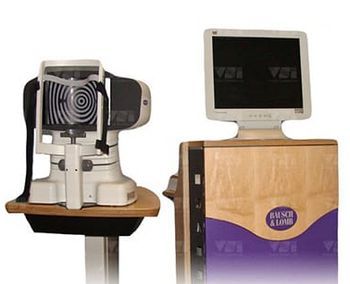
Bausch & Lomb Orbscan IIZ
 Bausch & Lomb · Model Orbscan IIZ
Acquires over 9000 data points in 1.5 seconds. Analyzes elevation and curvature measurements on both anterior and posterior surfaces of the cornea. Capable of detecting and analyzing posterior corneal abnormalities where corneal anomalies first appear. Features dynamic, Windows-based platform designed to integrate continuing advances via upgradable software. Customizable quad maps show any combination of measurements in one convenient format. Slit scanning technology combined with an advanced placido disc system Anterior corneal elevation and curvature. Posterior corneal elevation and curvature. Full corneal pachymetry. Simulated keratometry. White-to-white diameter. Pupil size (mesopic) Anterior chamber depth. Angle kappa Irregularity index.
Key tips
- ·Verify laser output with a real power meter, not the unit's own display - the display can drift independently of true output.
- ·Take "the image looks a little off" reports seriously - optical alignment drift is usually gradual, not sudden.
Typical Failure Modes
Compiled for this model from its own documentation and established engineering knowledge for this equipment class - not from a verified service record. Confirm against the manufacturer's service manual.
Optical / illumination fault
MediumSymptoms: Dim, uneven or no illumination; poor or hazy view; slit / filters not working.
Root cause: Bulb / LED at end of life, a power-supply fault, or contaminated optics.
Alignment / positioning-stage fault
MediumSymptoms: Joystick or slide binds, will not hold position, chin-rest / head-rest drive faults.
Root cause: Worn stage bearings / slides or a positioning-drive fault.
Measurement / capture fault
MediumSymptoms: Reading errors (tonometer / autorefractor / lensmeter), no or poor image capture (fundus / OCT), calibration fails.
Root cause: Sensor / camera fault, a calibration issue, or contaminated measurement optics.
Printer / PC / connectivity fault
LowSymptoms: No printout, images / data will not save or transfer.
Root cause: Built-in printer, the PC, or the network / EMR interface.
Motorised table / chin-rest fault (where fitted)
LowSymptoms: Instrument table or chin-rest will not raise / lower.
Root cause: Table / chin-rest actuator or its switch.
Serviceable Parts & Consumables
Serviceable items for this model, compiled from its documentation and engineering knowledge for this equipment class. Service class and relative cost are estimates, not manufacturer figures; no part numbers are given. Confirm intervals and pricing against the manufacturer.
Illumination bulb / LED module
Class Frequent wear itemRel. cost $$R&R Fairly easy
Positioning-stage bearings / slides
Class Major service partRel. cost $$R&R Moderate
Measurement sensor / camera module
Class Major service partRel. cost $$$R&R Moderate
Built-in printer / paper
Class Periodic replacementRel. cost $R&R Fairly easy
Chin-rest / table actuator
Class Major service partRel. cost $$R&R Moderate
| Part | Service class | Relative cost | R&R difficulty |
|---|---|---|---|
| Illumination bulb / LED module | Frequent wear item | $$ | Fairly easy |
| Positioning-stage bearings / slides | Major service part | $$ | Moderate |
| Measurement sensor / camera module | Major service part | $$$ | Moderate |
| Built-in printer / paper | Periodic replacement | $ | Fairly easy |
| Chin-rest / table actuator | Major service part | $$ | Moderate |
Relative cost: $ lowest · $$$$ highest service-part cost for this equipment class. Not a price.
PM Checklist
Preventive-maintenance tasks typical of this equipment class. Perform to the manufacturer's procedure and your facility's policy - this is general reference, not a schedule for this specific unit.
- ·Optical alignment / calibration check
- ·Lamp or laser output verification
- ·Annual full PM
Troubleshooting Approach
A starting sequence for this model, compiled from its documentation and engineering knowledge for this equipment class. Follow the manufacturer's service documentation for the actual procedure.
Symptom: Dim, uneven or no illumination
- Replace the bulb / LED module with the correct type.
- Check the power supply and rheostat / brightness control.
- Clean the illumination and viewing optics per the manual.
- Confirm the slit, filters and apertures operate.
- Replace the power supply if output is still low.
Symptom: Measurement or capture error
- Run the instrument self-test / calibration.
- Clean the measurement window / objective.
- Verify against a model eye / test target where one exists.
- Confirm patient positioning and fixation.
- Refer the sensor / camera module if calibration will not hold.
Typical Location
Where this class of equipment is typically deployed - general reference, not this unit's own placement record.
- Eye clinic / ophthalmology suite
- Operating Room (ophthalmic surgery)
Documents & Manuals
Safety & Recalls
Synced live from the FDA openFDA API.
- RECALL
The toric axis marks were misaligned (from the expected position in relation to the haptics) on an implanted lens.
- RECALL
The back cap separates from the body of the vitrectomy cutter.
- RECALL
Product was found to contain excess residual levels of hydrogen peroxide.
- RECALL
The firm determined that 25 lots had been manufactured with a minor surface defect occurring in the optical surface on each lens. Complaints of Halo or Poor Visual Acuity.
- RECALL
Haptics breaking during lens loading and insertion.
- RECALL
A software anomaly was identified where the system may automatically transition from "Standby" to "Ready to Fire" state while in surgical use.
- RECALL
Out of specification results for one of the two disinfectants.
- RECALL
Lens was manufactured with incorrect raw material.
- RECALL
Some disposable cannulas (with 4-digit lot numbers) provided with the Amvisc or Amvisc Plus OVD are not properly engaging to the Luer-Lock on the Amvisc and Amvisc Plus sterile glass syringes. The cannulas may leak viscoelastic material or detach from the syringe during injection. In rare incidents, detachment has resulted in serious patient injury.
- RECALL
Posterior fluidics modules installed in the system may need to be recalibrated.
- RECALL
The aspiration channel on the affected vacuum cassettes may be blocked due to a molding malfunction
- RECALL
There is a potential for some packages to not meet sterility requirements.
- RECALL
The amount of D&C #6 Dye added to the formulation exceeded specified amounts.
- RECALL
The AC power cords used on these products are subject to an FDA Alert -- Safety Investigation of Certain Medical Device Power Cords: Initial Communication, Date Issued: October 19, 2009.
- RECALL
Users may incorrectly assemble the plastic needle wrench to the phacoemulsification needle resulting in the generation of plastic particulate
- RECALL
Bausch & Lomb Incorporated, Rochester, NY is recalling their Silicone L161SE Intraocular Lens Lot 4916928 (23.5D) after receiving three customer complaints for what appears to be opacification of the intraocular lens. The opacification occurred within one week of implantation. In each reported case the surgeon explanted the lens.
- RECALL
The product failed to meet Out of Specification shelf life at the 9 months time point. This could result in increased risk of an ocular infection, especially in the presence of other contributing or risk factors.
- RECALL
During routine testing the product failed to meet shelf life specifications.
- RECALL
The product failed to meet one of the shelf life specifications at the end of the expiry period.
- RECALL
Affected lenses were inadvertently shipped to Bausch & Lomb's European Logistics Center (ELC) prior to release authorization. Initial testing indicated the product did not meet release criteria for endotoxin limits.
- RECALL
The plastic tip on the drive shaft may come off the shaft and cause the blade to stop oscillating.
- RECALL
The directions for use are printed with the incorrect symbols to indicate the product is packaged as sterile and nonreusable
- RECALL
Reports have been received of stromal incursions after use of the product.
- RECALL
A higher than expected amount of trace iron in some bottles of finished product that over time affects the product's stability and color.
- RECALL
The cutter probe tip breaks during use.
- RECALL
The cutter tip could break during a procedure
- RECALL
Reports of Fusarium Infections among contact lens wearers.
- RECALL
Portion of lot contains lenses with incorrect refractive power.
- RECALL
The firm's DP8200 Microflow Needle Packs were labeled with the firm's DP8115 Phaco Needle Packs and visa versa.
- RECALL
Lenses labeled as -2.25 diopter contain -0.75 diopter lenses.
Troubleshoot this device with Bio
Describe a symptom or error code. Bio answers from this device's own documented error codes, failure modes, parts, and guides.
Ask Bio